

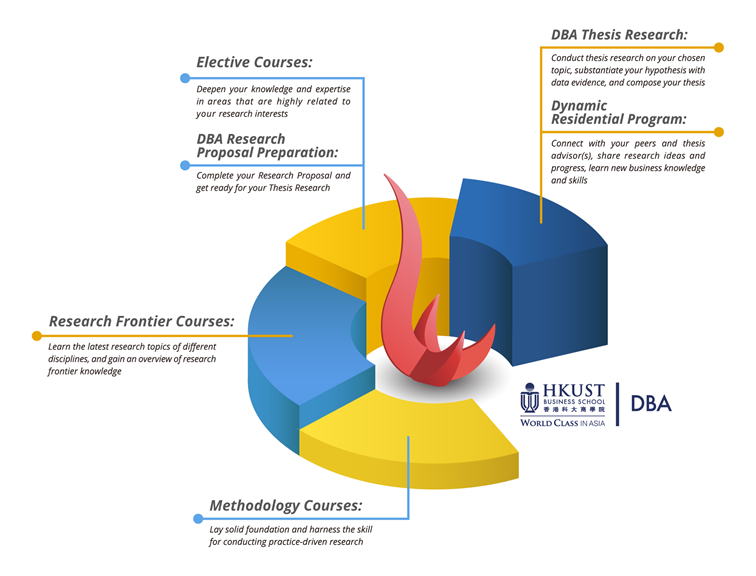
A rigorous curriculum is designed to equip students with a portfolio of skills for conducting applied research.

This course explores the fundamental issues in business research, including the purpose of business research, the role business research plays in helping managers in decision making etc.
The course introduces various applications of statistics in business, in particular, regression analysis and its applications. The main topics to be covered include data exploration methods, inference, and regression.
This course provides an introduction to survey research with a focus on its applications in business research. Students will gain the knowledge and skills needed to design and conduct surveys, analyze survey data, and apply survey research methods.
This course covers when and how to conduct inductive multiple case research, focusing on specific skills such as how to identify a research question that fits multiple case research, craft a rigorous research design, use theoretical sampling, conduct within- and cross- case comparisons etc.
This course focuses on experimental research methods in the field of business. It provides students with an introduction to the tools and techniques necessary for collecting, analyzing, interpreting, and evaluating experimental data.
This course is designed to provide students with a comprehensive understanding of applied microeconomic theory at the DBA level. The course will delve into foundational topics such as consumer theory, game theory, and industrial organization.
This course focuses on frontier accounting research topics such as corporate social responsibility (CSR) reporting, and discusses papers that cover issues and topics such as corporate disclosures, firm valuation, financing, and different stakeholders of a firm.
This course introduces students to frontier topics in economics research relevant for business, including topics such as economic institutions (firms and markets), empirical research strategies, innovation, globalization, and labor and personnel economics.
This course gives a “helicopter tour” of the theory and empirical work in mainstream academic finance research. Major finance research areas will also be introduced: asset pricing and investment theories and practice, corporate finance issues, microstructure studies, and financial derivatives pricing and strategies.
This course provides a condensed introduction to frontier research in information systems. Because the application of IS and technologies continues to evolve, we can only sample latest developments in topical areas including information privacy, information security, digital platforms and innovations, and the impact of IS on the society.
This course exposes students to the current research in operations management, and focuses on research questions and findings, particularly how they are related to business practices, whereas research methodologies will not be emphasized.
This course exposes students to the latest research and trends in management research (e.g., organizational behavior, human resources management, strategic management, international business, entrepreneurship, and business ethics)
This course discusses important areas of academic research in marketing, with a particular focus on methodologies to uncover causality. Students will be exposed to academic research papers on different topics, such as social media marketing, consumer decision making, visual attention and so on.
Students will work out a study plan with advisor(s) to take at least 4 elective courses from the following list in Year 2.
The above elective courses are subject to change at the discretion of the HKUST DBA Program Office.
Students are required to complete an independent study advised by the advisor(s) in Year 2.
Students are required to participate in DBA Residential Program (2-day residential programs for research activities) during regular terms starting from Year 3. Students are expected to attend 4 times of DBA Residential Program before they graduate. Exceptional cases can be considered with the approvals from DBA Program and Dean’s office. Students are also expected to set up real-time meetings online or offline with their advisors for a minimum of 10 contact hours per regular term (20 hours per academic year).
Note: The credits earned from DBAP 6300 cannot be counted toward the program’s credit requirements.
In completion of Thesis Preparation in Year 2, students will proceed to the DBA research and thesis write-up in Year 3 and Year 4. Students are required to present the DBA thesis and defend orally in front of the Thesis Examination Committee, normally by end of Year 4.
The program will be conducted in English.